Watch
68-second tour of the live Pow-Wow Intranet demo, cut to the soundtrack. Vertical cut for social: helm-powwow-reel.mp4
Volume
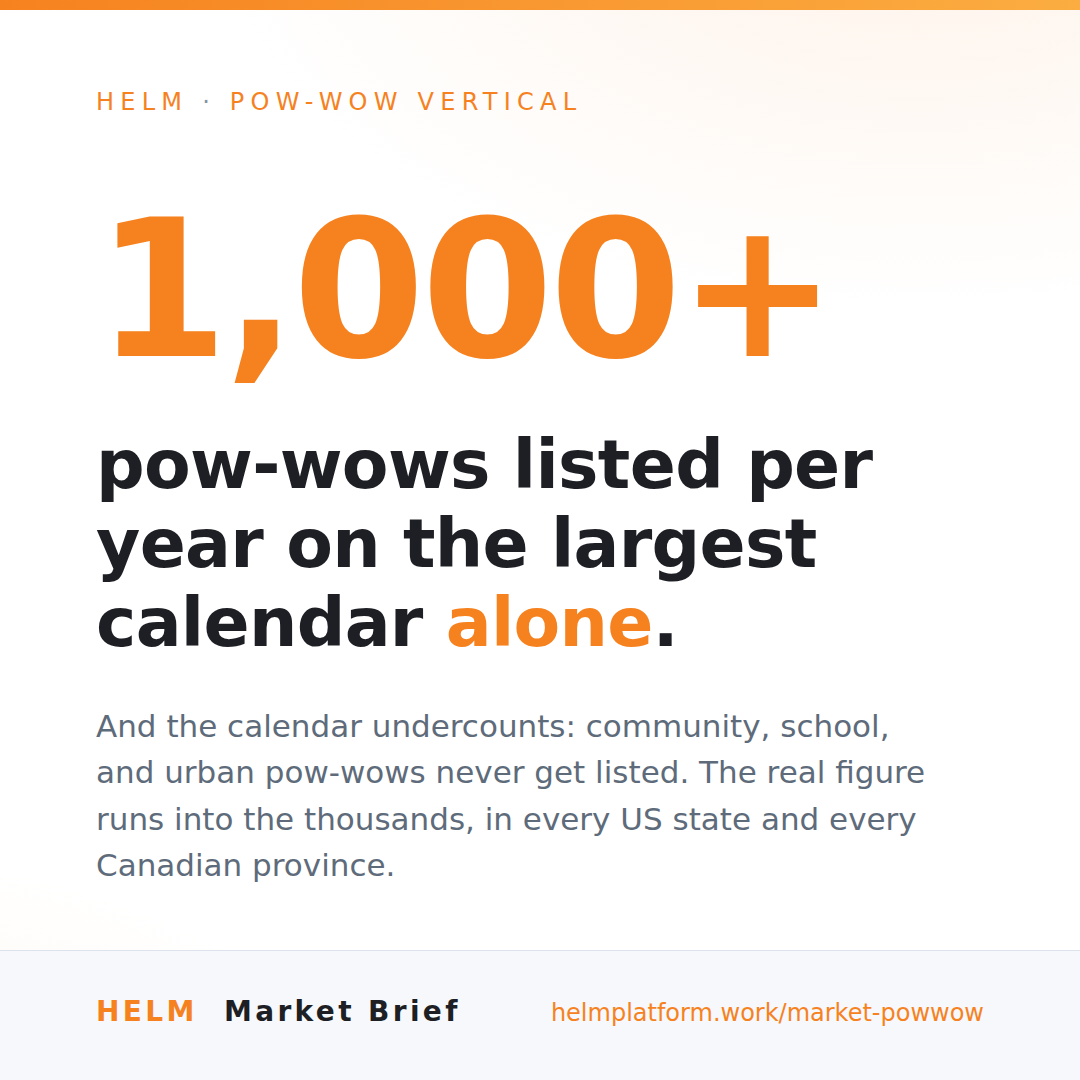
PowWows.com lists over 1,000 events a year, and that calendar undercounts: many community, school, and urban pow-wows never get listed. The commonly cited figure is thousands annually, held in every US state and every Canadian province. Alberta alone runs 20+ a year; Saskatchewan is comparable.
Behind the events sits the customer universe: 574 federally recognized US tribes, 630+ First Nations in Canada, plus universities, friendship centres, and urban Indigenous organizations that host their own annual pow-wows.
Money Per Event
Contest pow-wows move real money, and it moves through exactly the workflows software should own: registration, tabulation, and payout sheets.
| Tier | Adult 1st place | What the event carries |
|---|---|---|
| Community | $100 or less | Honoraria, feast, giveaway; run by volunteers on paper |
| Regional contest | $700 to $1,500 | Total dance payouts documented at $48,000+; drum contests carry $30,000 pools with $10,000 top prizes; vendor rows, billeting, Elder transport |
| Major | up to $2,500 | 100,000+ attendees, 700+ nations, eight-figure economic impact on the host city |
Add drum stipends, booth fees, and travel, and a mid-size contest pow-wow is a $75,000 to $250,000 operation run almost entirely on spreadsheets and a cash box.
The Kyi-Yo pow-wow came up roughly $15,000 short on dancer payouts in a single year. Tabulation and treasurer chaos is not hypothetical; it is the pain the platform removes.
The 2026 Window
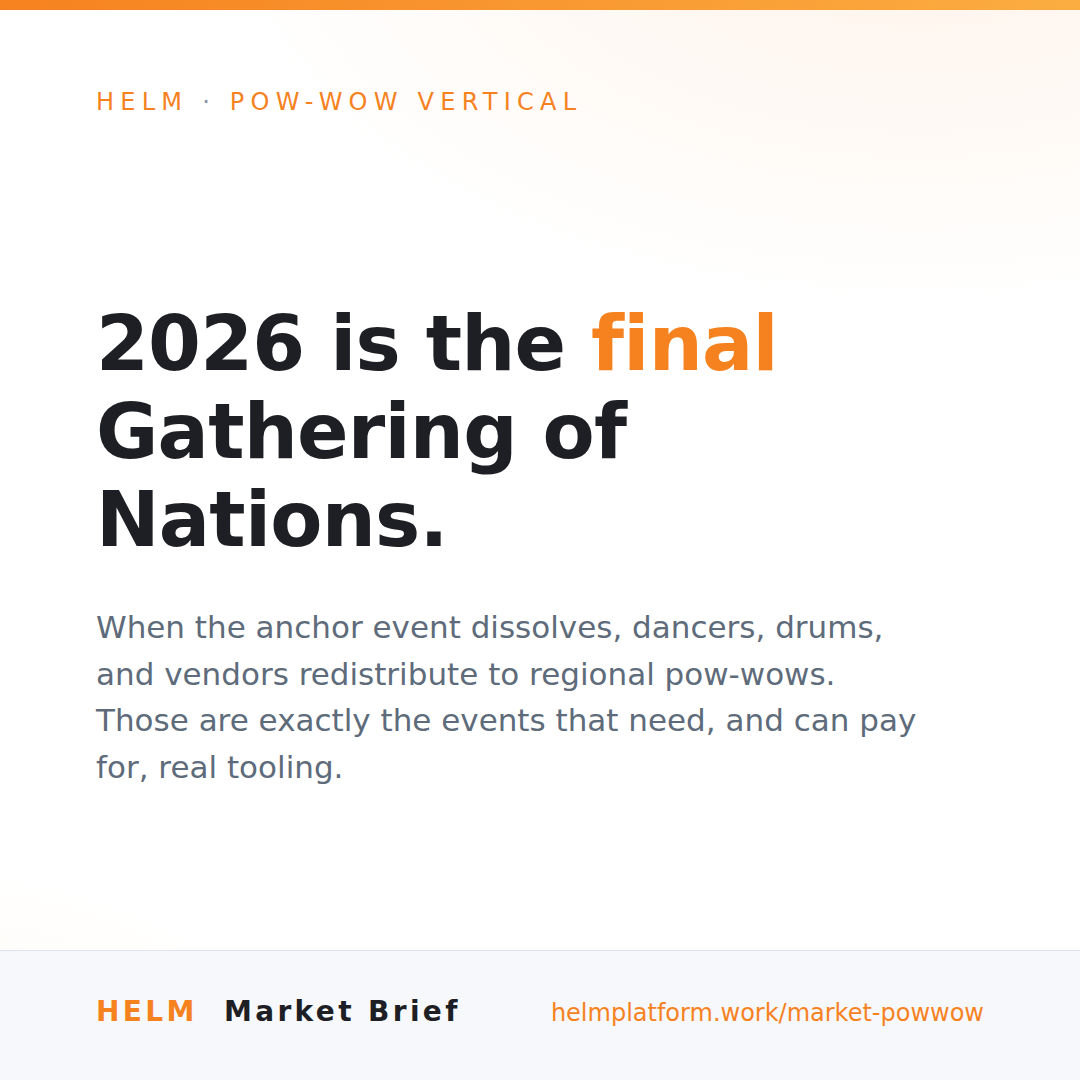
Gathering of Nations in Albuquerque, the continent's anchor event, draws 100,000+ attendees and roughly $30M in economic activity. Its organizers announced that 2026 is its final year. When the anchor dissolves, dancers, drums, and vendors redistribute to regional pow-wows, which grow and professionalize. Those regional events are precisely the tier that needs, and can pay for, real tooling.
Competition
There is no purpose-built pow-wow management platform. The adjacent tools are generic dance-competition suites (DanceComp Genie, CompetitionSuite, TourPro): they do registration and scoring but know nothing about Grand Entry order, drum rotation, category and age divisions, honour songs and protocol, payout sheets, or vendor rows.
The realistic incumbent is Excel plus a cash box.
The Fit
Four things committees notice in the demo, because they map to how a pow-wow actually runs:
It lives on phones. Helm installs like an app. The registration desk, the arena director, and the vendor coordinator all work from the grounds, with push alerts and push-to-talk radio built in. No laptop tent required.
Every stakeholder hears back. Dancers, drums, vendors, volunteers, and sponsors each get their own window into the event: portals, published schedules, and decision dispatches. The committee stops being a switchboard.
It joins your email instead of replacing it. Helm syncs the committee's existing shared inbox, so applications and questions become assigned, tracked conversations, without changing addresses, providers, or anyone's habits mid-season.
The cycle is baked in. Registration to Grand Entry to payouts to grant reporting, encoded as checklists, approvals, and an audit log. New organizers learn how it is done by following the platform; veteran committees walk into an audit with the receipts already in order.
It multiplies instead of metering. There is no per-seat charge, and volunteers are the point, not the cost. Every person you add gets the app and instantly carries the whole kit: the shared inbox without ever holding its password, a push-to-talk radio in their phone, team chat, the task board, their role's training checklist, their shift's QR check-in, the live site map, and an offline gate scanner: the ticket list downloads to the phone, so scanning keeps working when the grounds lose signal. More hands make the event stronger, not the invoice bigger.
Confidence. A committee that walks into the weekend knowing where every dancer, every dollar, and every decision stands.
Serviceable Market
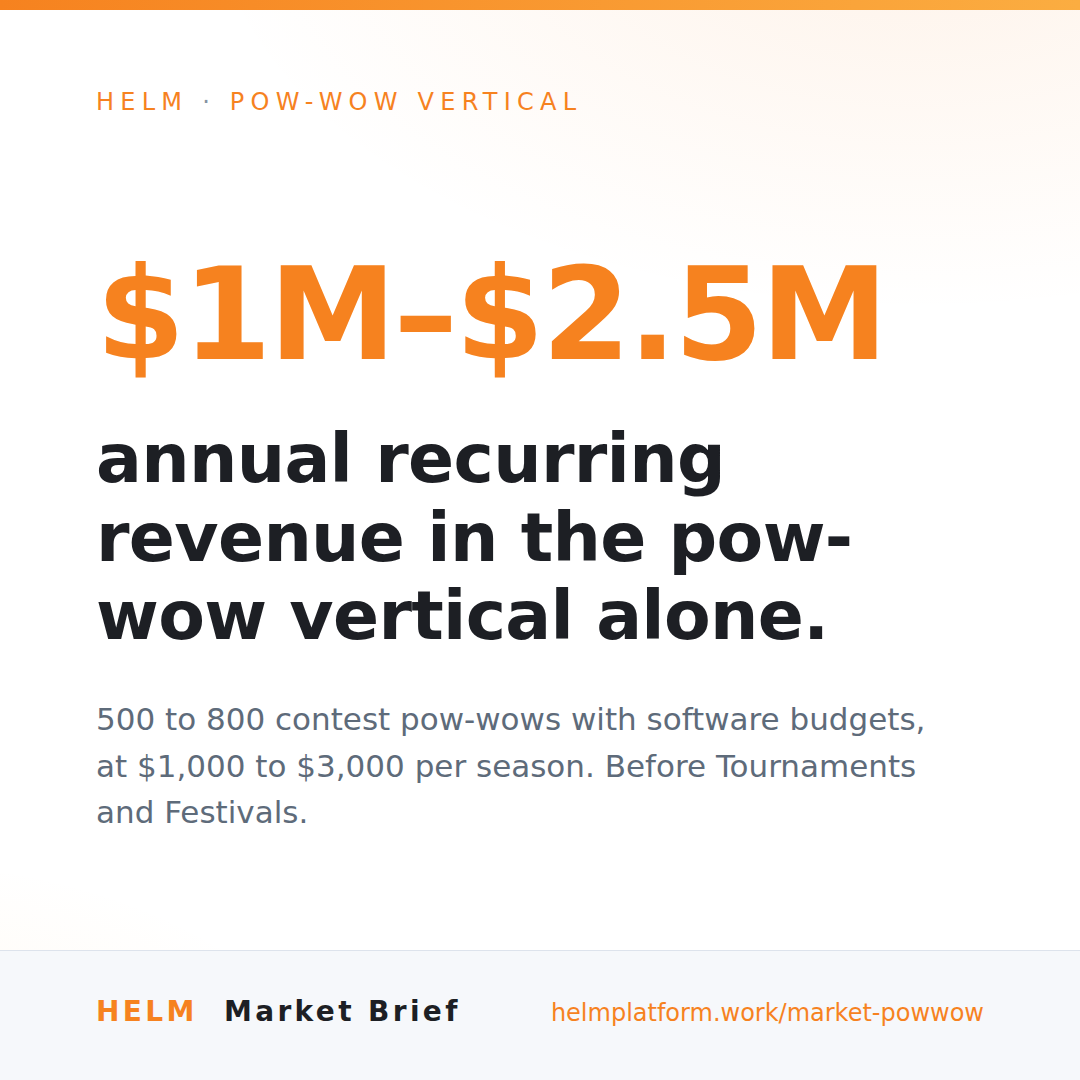
of which 500 to 800 are contest pow-wows with budgets that support software
at $1,000 to $3,000 per season
= $1M to $2.5M ARR in the pow-wow vertical alone, before Tournaments and Festivals
Small as a venture story. Solid as a bootstrapped niche where the only purpose-built player sets the standard.
Beachhead
The natural first circuit from Regina is the prairies: Treaty 4 and Treaty 6 events and the FSIN network of 70+ Saskatchewan First Nations. The demo instance is already dressed for that pitch, with Grand Entry scheduling, drum and dancer registries, competition workstreams, and payout tasks live behind a login.
Share This Brief
Ten ready-to-post 1080×1080 tiles built from the numbers above, each with a caption and this page's link. Download or share straight from your phone.